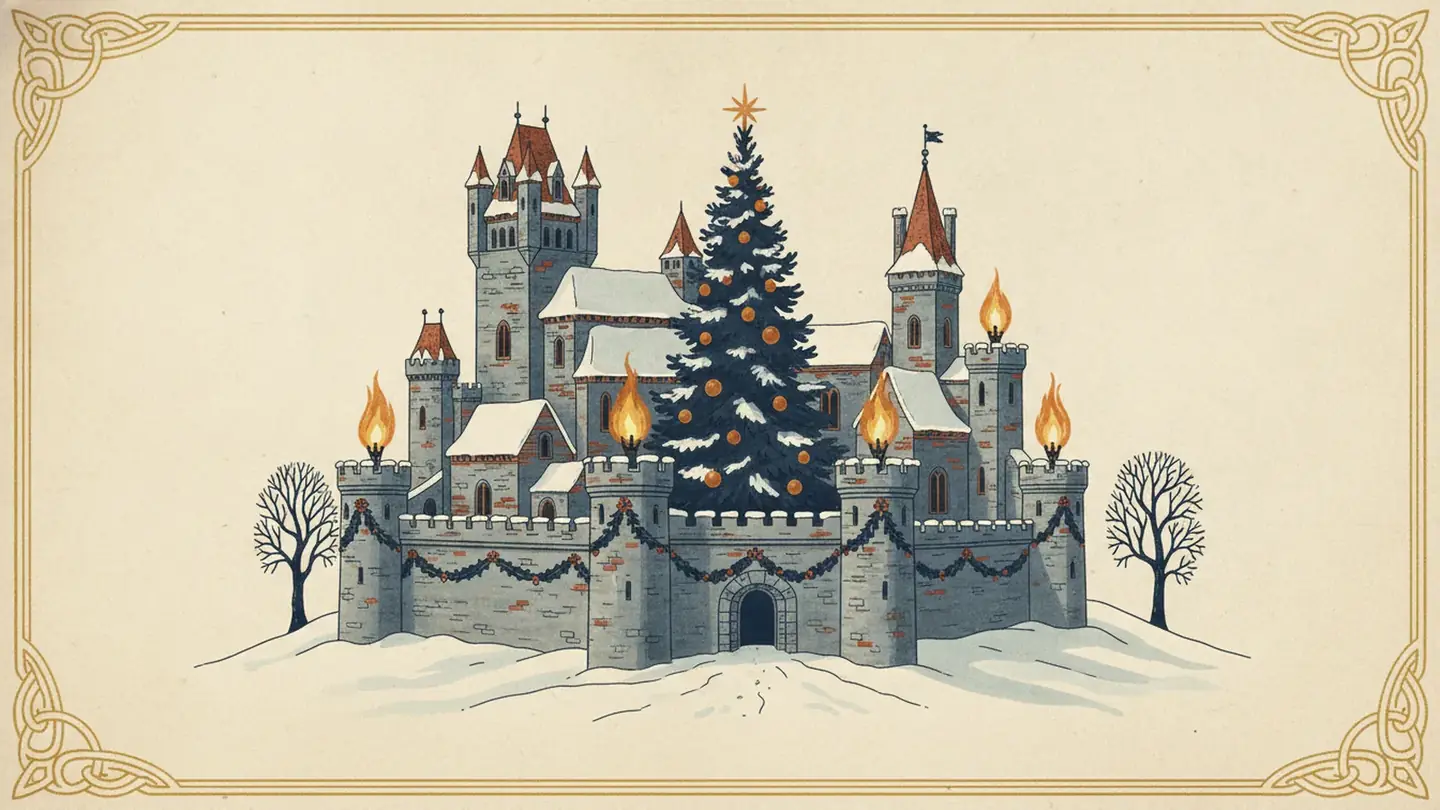
The silent T: castle, Christmas, often and fasten
Some English T's were pronounced for centuries and then dropped out of speech, while staying in the spelling. Most of them sit in the same place: after an S (or F), right before a weak syllable ending in L, N or M — castle, listen, fasten, often, Christmas.
Saying S-T-L or S-T-N with a fully weakened final syllable is awkward, and around the 17th century English speakers simplified the cluster by dropping the T. The spelling had already been settled, so the T stayed on the page.
Each word below has its full story on its own page.

castle
Castle comes from Latin castellum, and the T was once pronounced. English dropped it around the 1600s — the same change that silenced listen.
- Then · Old English / Old Northern French
- castel
- Say it
- KASS-ul
Christmas
Christmas is Christ's mass — Old English Cristes mæsse. Here is why the T went silent and why the "eye" of Christ became the short "i" of Christmas.
- Then · Old English
- Cristes mæsse
- Say it
- KRISS-muss
often
The T in often went silent in the 1600s, then came back. Here is why both OFF-en and OFF-ten are correct, and which one is more traditional.
- Then · Old English
- oft
- Say it
- OFF-en

fasten
Fasten is built from fast, as in "hold fast", and the T was once said. Here is how it went silent, and why fast and fasten no longer match.
- Then · Old English
- fæstnian
- Say it
- FASS-en
The one that came back
Often is the odd one out. Its T was dropped like the others, but because the letter is right there in the spelling, many speakers started pronouncing it again — a spelling pronunciation. Today both OFF-en and OFF-ten are accepted. Nobody has done the same for castle or fasten: "KAS-tul" and "FAS-ten" still sound wrong to native ears.
What this means for your accent
In this pattern — S or F, then T, then a weak -le, -en or -mas — leave the T out. Go straight from the S to the next consonant: KASS-ul, FASS-en, LISS-en, KRISS-muss. For often, either form is fine.
Questions people ask
+Why is the T silent in castle and listen?
Around the 17th century English dropped T between S and a final syllabic L or N. The spelling, already fixed, kept the letter.
+Should I pronounce the T in often?
Either is accepted. OFF-en is the traditional pronunciation; OFF-ten is a spelling pronunciation that many native speakers use.
More word stories
Why English spelling doesn't match the sound
Silent letters, odd vowels, colonel said "kernel": the three reasons English spelling stopped matching speech, with a story for each word.

The days of the week: gods, planets and lost sounds
Why the English days of the week are named after Woden, Thor, Frigg and Saturn, and how each name is pronounced in American English today.
The silent K: knight, knee, know and knife
Why English writes a K in knight, knee, know and knife but doesn't say it — the kn- sound was pronounced until the 1600s.

The silent W: write, wrong, two, sword, answer
Why English spells a W in write, wrong, two, sword and answer but doesn't say it. Every one of those Ws was once a real sound.

The silent B: lamb, comb, thumb, debt, doubt
Some silent Bs were once pronounced (lamb, comb); others never were (thumb, debt, doubt). How to tell a lost sound from a letter that was added.

The lost GH sound: night, daughter, laugh and though
English GH was once a real sound, like German Nacht. Here is how it went silent in night and daughter but turned into F in laugh.

Silent letters that were never pronounced
The B in debt, the P in receipt and the S in island were never said. Scholars added them to make English look Latin. Here is the full story.

The silent L: walk, half, calm, could and salmon
Why the L is silent in walk, half, calm, folk and should — and why could and salmon have an L that was never pronounced in the first place.