The story
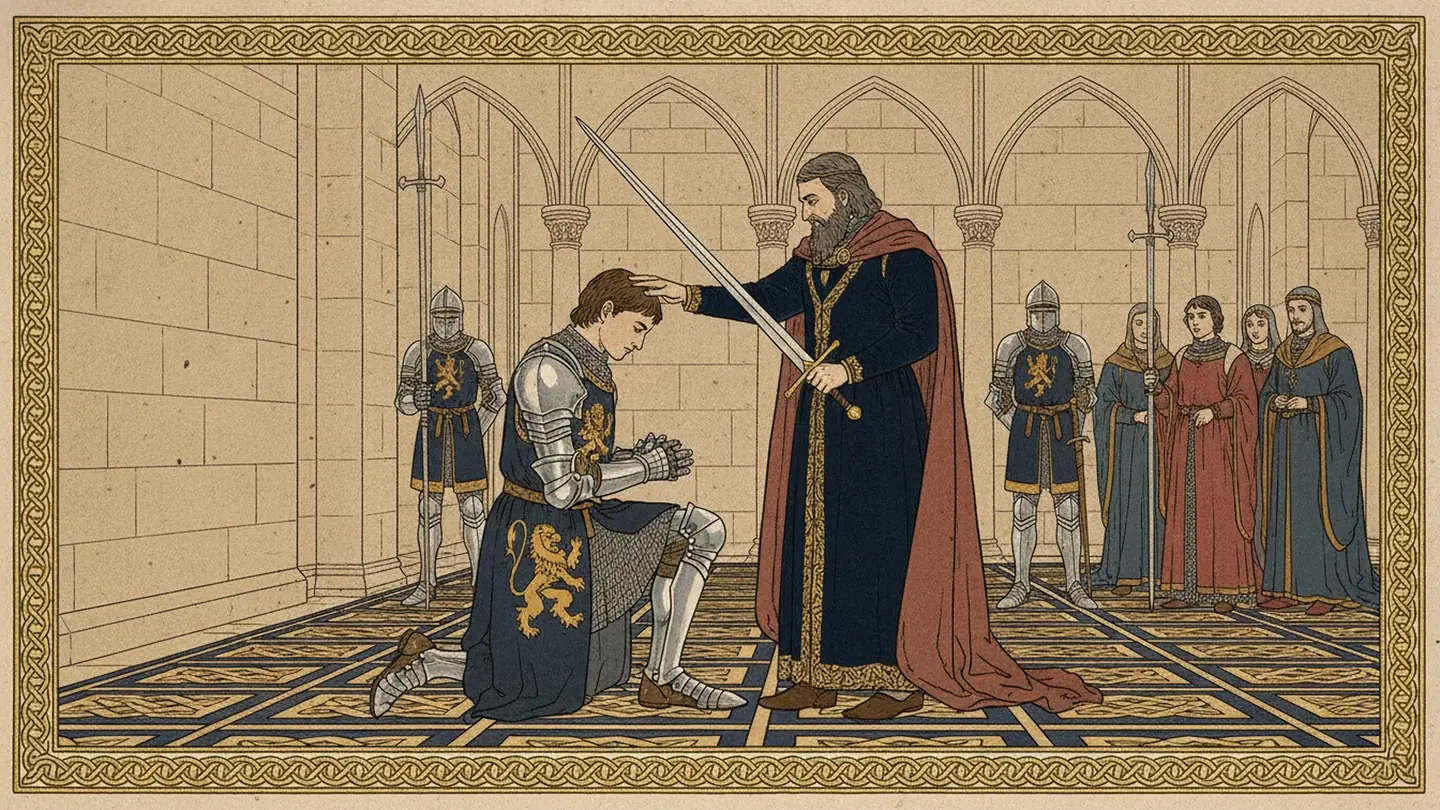
Knight began life as a humble word. Old English cniht meant "boy" or "servant" — a young man who served someone. Its close relative in German, Knecht, still means "servant" or "farmhand". Only in English did the word climb the social ladder, coming to mean a mounted warrior in a lord's service and finally a title of honor.
Old English speakers pronounced every letter. The word began with a real K followed by an N, and the h (later written gh) was a throaty breathy sound, like the ch in German ich or Scottish loch. Roughly: k-NIKHT.
Both sounds then fell away. The throaty GH faded in most of England by the end of the Middle Ages, and the vowel lengthened to make up for it — the long vowel that the Great Vowel Shift later turned into "eye". The K went later: the kn- cluster was simplified to plain N in educated English during the 1600s.
By then the spelling had long been fixed by scribes and printers. That is why knight and night — once quite different words — now sound exactly the same.