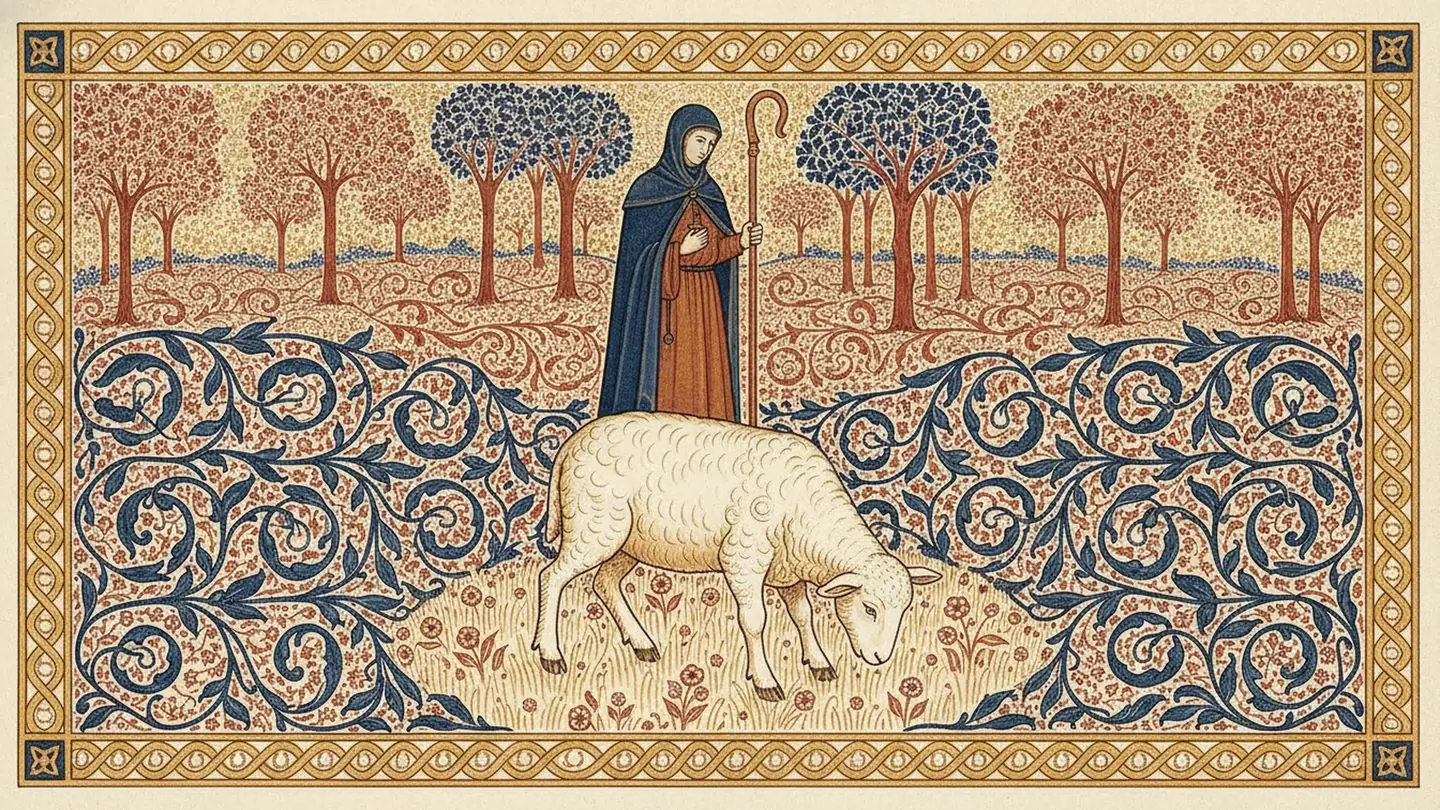
Illustration: the history of the word lamb
lambsilent
A sound people stopped saying

Why is the B in lamb silent?

In Old English, lamb was said with a final B. Later Middle English reduced -mb to -m, so lamb now rhymes with ham. Here is the story of the B.

Then · Old English

lamb

said like LAHMB

later Middle English (1300s-1400s)↓

Now · American English

lamb/læm/

said LAM

The story

Lamb has hardly changed its spelling in over a thousand years: Old English wrote it lamb, just as we do. What changed is the sound. In Old English the final B was pronounced — the word ended "-mb", with the lips closing for M and then releasing a B. German and Dutch, which share the word, say Lamm and lam.

In later Middle English, speakers reduced a word-final -mb to plain M. The B was silent from then on in lamb, comb, climb, womb and plumb. The letter stayed, because spelling had settled before the sound was lost.

A good rule of thumb: an -mb at the very end of a word is always silent in modern English — and it usually stays silent when an ending is added (lambing, climber, plumber).
How the word changed

  1. 1

    Old English (before 1100)

    lamb

    Final B pronounced. Cousin of German Lamm.

  2. 2

    Later Middle English (1300s-1400s)

    lamb

    Final -mb reduces to -m.

  3. 3

    Modern English

    lamb

    LAM — the spelling is unchanged since Old English.

Listen + practice

Hear “lamb” spoken naturally

Pick a sentence to record

Read the sentence aloud. Keep the stress on the particle and run the two words together — we’ll score every sound and flag what to work on.

Click to record

Questions people ask

+Was the B in lamb ever pronounced?

Yes. In Old English the word ended with a real -mb. Later Middle English reduced final -mb to -m.

+Why are there silent Bs in lamb, comb and climb?

All three once ended in a pronounced -mb, which English simplified to -m in later Middle English. The spelling kept the B.

Part of

Why is the B in lamb silent?