
American English sound
/n/: how to pronounce “n” in now, money and ten
/n/ is made with the tongue tip on the gum ridge behind the upper teeth while your voice hums through your nose: now, money, ten.
The difficulty is usually at the end of a word: some Chinese speakers merge it with /ŋ/ (thin and thing), French and Portuguese speakers may only nasalize the vowel, and a few languages mix n and l.
/n/
the “n” sound
How to make the sound
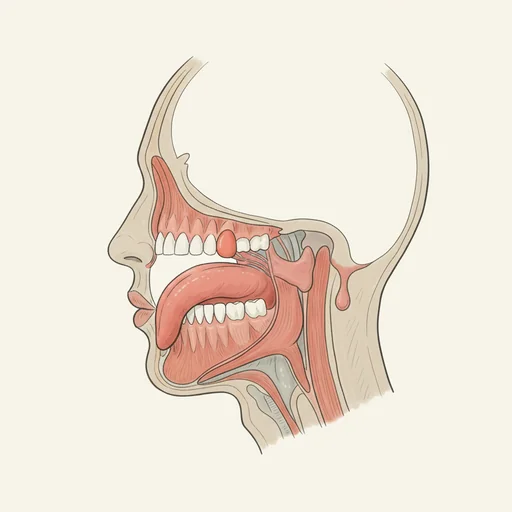
- 1Touch the tip of your tongue to the gum ridge behind your upper teeth.
- 2Hum: your voice should come out through your nose.
- 3At the end of a word, keep the tongue tip up until the hum finishes.
- 4Keep the back of the tongue down, or it becomes the ng of sing.
- Tongue
- tip-alveolar
- Lips
- neutral
- Voice
- voiced
Hear it in words
Tap a word to hear it.
At the start
In the middle
At the end
How it's spelled
- n / nn: now, dinner, ten
- kn / gn: know, knife, sign
Common mistakes
Using ng: “thing” for thin
If the back of the tongue rises, thin becomes thing and win becomes wing. Use the tongue tip.
Nasalizing instead
A nasal vowel without a real n (“te(n)”) sounds foreign. Touch the ridge with the tongue tip.
Mixing n and l
If night sounds like light, check the air: for n it goes through the nose; for l it flows around the tongue.
Who finds /n/ hard
Speakers of these languages often replace it with a sound from their own language. Linked languages have their own accent traps page.
Often drop the sound
Chinese
Minimal pairs
Each pair differs by one sound. If both words sound the same when you say them, practice this pair.
Try it
“Nine new neighbors came to dinner at ten.”
Record a sentence and get a score for every sound, /n/ included. Free, no account.
Questions
How do I tell n from ng at the end of a word?
For n the tip of the tongue touches the ridge behind the teeth (thin); for ng the back of the tongue touches the soft palate and the tip stays down (thing).
Why are the k in know and the g in sign silent?
English dropped those consonants before n centuries ago, but kept the spelling. Know, knife, sign and design all start or end with a plain /n/.