
American English sound
/h/: how to pronounce “h” in hat, house and behind
/h/ is just breath: air flowing out of an open mouth, already shaped for the next vowel. Hat, house and help all start with it.
Learners tend to make one of two opposite mistakes: dropping it (French and Italian speakers: hair becomes air), or making it rough from the back of the throat (Spanish, Russian and Arabic speakers).
/h/
the “h” sound
How to make the sound
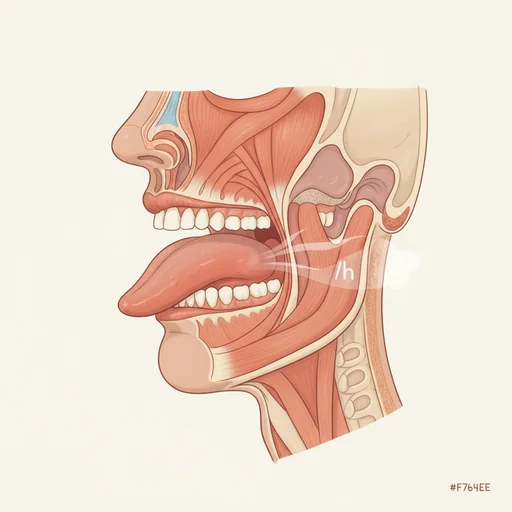
- 1Shape your mouth for the vowel that follows.
- 2Breathe out softly through the open mouth, as if fogging up a mirror.
- 3Keep your throat relaxed: no friction, no scraping.
- 4Slide straight into the vowel.
- Tongue
- tip-down
- Lips
- neutral
- Voice
- voiceless
Hear it in words
Tap a word to hear it.
At the start
In the middle
At the end
/h/ never ends an English word: it's always followed by a vowel.
How it's spelled
- h: hat, house, behind
- wh (some words): who, whole, whose
- silent h: hour, honest, honor, ghost
Common mistakes
Dropping it: “air” for hair
French and Italian have no /h/. Breathe out before the vowel; it should be audible.
A rough throat sound
The Spanish j, Russian x or Arabic kh is too harsh. American /h/ is only breath.
Pronouncing silent h
Hour, honest and honor start with a vowel: “an hour”, “an honest man”.
Who finds /h/ hard
Speakers of these languages often replace it with a sound from their own language. Linked languages have their own accent traps page.
Often drop the sound
French, Italian, Portuguese
Minimal pairs
Each pair differs by one sound. If both words sound the same when you say them, practice this pair.
Try it
“Harry hopes his house will have a huge hall.”
Record a sentence and get a score for every sound, /h/ included. Free, no account.
Questions
Is the h in “him” and “her” pronounced?
In careful speech yes, but in fast, unstressed speech Americans often drop it: “tell 'im”, “ask 'er”. At the start of a sentence or when stressed, keep it.
Why is it “an hour” but “a house”?
An is used before a vowel sound. Hour starts with a vowel sound because its h is silent; house starts with /h/.